Let’s dive into the exciting world of Bitcoin. Right now, Bitcoin’s market cap is a whopping $1.91 trillion. With a max supply capped at 21 million bitcoins, it’s no wonder this digital gold is such a hot topic and such a scarce asset.
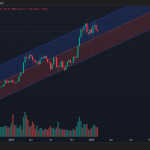
Currently, Bitcoin is priced at $96,292, and it’s been on a steady rise on the weekly chart. The linear regression channel indicates significant resistance at $109,000 and strong support at $92,000. This sets the stage for potential price movements and strategic trading.
Support and Resistance Levels
The support level at $92,000 has been a strong foundation for Bitcoin, acting as a critical price floor during recent market fluctuations. On the other hand, the resistance level at $109,000 represents a key barrier that Bitcoin needs to overcome to reach new all-time highs. Support and resistance levels are crucial in understanding Bitcoin’s price movements and overall trend. Support levels act as a price floor, where buying interest is strong enough to prevent the price from falling further. This helps identify potential entry points for investors. Conversely, resistance levels serve as a price ceiling, where selling pressure is significant enough to cap further price increases. Recognizing these levels enables traders to make informed decisions, manage risk, and predict potential price reversals or breakouts, ultimately guiding their investment strategies in the volatile cryptocurrency market.
Market Sentiment
The overall sentiment in the Bitcoin market remains cautiously optimistic. While some investors are bullish about the potential for Bitcoin to break through the $109,000 resistance, others remain wary of potential pullbacks. A $120,000 Bitcoin is possible by the end of 2025. Despite the volatility introduced by President Trump’s trade wars, the cryptocurrency market, particularly Bitcoin, remains bullish due to several factors. Institutional demand for Bitcoin has surged, reaching unprecedented levels. Additionally, the potential for Bitcoin to be adopted as a strategic reserve asset by governments has bolstered investor confidence. The overall economic uncertainty has also driven investors towards Bitcoin as a hedge against traditional market fluctuations. These factors collectively contribute to the sustained bullish trend in the cryptocurrency market.
Future Potential
Looking ahead, some experts are predicting a future price target of $120,000 per bitcoin. This presents an exciting opportunity for investors, as breaking through the resistance levels could pave the way for significant gains.
Technical Indicators
The linear regression channel provides valuable insights into the market’s trend direction and potential price movements. By analyzing this indicator, investors can better understand the market’s momentum and make informed trading decisions. Several indicators suggest that Bitcoin may continue to rise in the long term. The Stock-to-Flow (S2F) model, which measures Bitcoin’s scarcity, indicates that Bitcoin is currently undervalued. Additionally, the Pi Cycle Top Indicator and Rainbow Price Chart suggest that Bitcoin has not yet reached its peak, with potential future targets significantly higher than current prices. These indicators, combined with increasing institutional adoption and macroeconomic factors, paint a bullish picture for Bitcoin’s long-term growth.
Investment Strategies
For long-term investors, holding onto Bitcoin through market fluctuations can be a viable strategy. The support level at $92,000 offers a safety net, while the potential for breaking through the $109,000 resistance presents an opportunity for significant gains. A dollar-cost averaging (DCA) strategy involves buying Bitcoin at regular intervals, such as weekly, regardless of its current price. This approach helps smooth out the cost of purchasing Bitcoin over time, reducing the impact of short-term market volatility. By consistently investing a fixed amount, investors can average out the purchase price, potentially lowering the overall cost and mitigating the risk of making large investments during market peaks. Over the long term, this strategy can lead to more stable returns and reduce the emotional stress of trying to time the market perfectly.
Short-term traders might consider taking advantage of price movements within the support and resistance levels. Buying near the support level and selling near the resistance level can yield profitable trades.
External Resources
To stay updated on the latest Bitcoin trends and market data, check out these resources:
– [CoinMarketCap](https://coinmarketcap.com/)
– [CoinGecko](https://www.coingecko.com/en/coins/bitcoin)
Influential Figures in Crypto
Here are some influential voices shaping the crypto space:
– Satoshi Nakamoto: The mysterious creator of Bitcoin: https://bitcoin.org.
– Elon Musk: A major advocate and influencer in the crypto world: https://en.wikipedia.org/wiki/Elon_Musk.
– Caitlin Long: A prominent advocate for Bitcoin and blockchain technology: https://caitlin-long.com/.
Here at Inbox27.com, we’re all about bringing you the latest and greatest in the crypto universe. Stay tuned for more insights and updates.
Connect with Inbox27.com
We’re all about bringing you the latest and greatest in the crypto universe here at Inbox27. We’d love to hear your thoughts, feedback, and comments! Feel free to reach out to us at contact@inbox27.com. Your input helps us continue providing valuable insights and updates.
If you found this content valuable, support us by sharing this article with your friends or family!