The Million-Dollar Mistake: Why Selling Your Bitcoin Today Could Be Tomorrow’s Greatest Regret
The Million-Dollar Mistake: Why Selling Your Bitcoin Today Could Be Tomorrow’s Greatest Regret
The stories are legendary. The pizza guy who spent 10,000 Bitcoin on two Papa John’s pizzas in 2010. The early adopter who sold 1,000 Bitcoin at $1 each to pay rent. The trader who panic-sold during the 2017 crash, only to watch Bitcoin soar to new heights. These aren’t just cautionary tales—they’re expensive lessons in the psychology of wealth building and the transformative power of truly scarce digital assets.
The Graveyard of Premature Sellers
Throughout Bitcoin’s relatively short history, we’ve witnessed countless examples of individuals who sold their holdings too early, only to watch in horror as their former assets reached astronomical valuations. These stories serve as powerful reminders of what happens when short-term thinking meets revolutionary technology.
Consider James Howells, the British IT worker who accidentally threw away a hard drive containing 7,500 Bitcoin in 2013. At today’s prices, that’s hundreds of millions of dollars sitting in a Welsh landfill. Or think about the thousands of early miners who sold their Bitcoin for mere dollars, treating it as “fun money” rather than recognizing its potential as the world’s first truly scarce digital asset.
The pattern is clear: those who held onto their Bitcoin through multiple market cycles have been rewarded exponentially, while those who sold during temporary price spikes lived to regret their decision. This isn’t just about luck—it’s about understanding the fundamental nature of what Bitcoin represents.
Why Bitcoin Is the Ultimate Store of Value
Digital Scarcity in an Infinite World
Bitcoin’s revolutionary breakthrough wasn’t just creating digital money—it was solving the double-spending problem and creating genuine digital scarcity. With only 21 million Bitcoin that will ever exist, we’re witnessing the birth of the first truly finite asset in human history.
Unlike gold, which can still be mined from the earth or even asteroids in the future, Bitcoin’s supply cap is mathematically guaranteed. No government can print more Bitcoin. No central authority can inflate the supply. This absolute scarcity becomes more valuable as global wealth increases and more people seek protection from monetary debasement.
The Network Effect Multiplier
Bitcoin’s value isn’t just derived from scarcity—it’s amplified by network effects. Every new user, every institutional adoption, every country that recognizes Bitcoin strengthens the entire network. We’re still in the early phases of global adoption, with most major corporations, pension funds, and sovereign wealth funds holding minimal or zero Bitcoin allocations.
As Michael Saylor frequently points out, Bitcoin is not just competing with other currencies—it’s competing with every store of value: real estate, stocks, bonds, commodities, and art. When viewed through this lens, Bitcoin’s current market capitalization represents a tiny fraction of global wealth storage needs.
The Central Bank Devaluation Machine
The Hidden Tax of Inflation
Central banks around the world have embarked on an unprecedented experiment in monetary expansion. Since 2008, money printing has accelerated to levels that would have been unthinkable to previous generations. The Federal Reserve’s balance sheet has expanded from under $1 trillion to over $8 trillion in just over a decade.
This monetary expansion doesn’t occur in a vacuum—it systematically devalues every dollar, euro, yen, and pound in existence. While politicians promise that this money creation stimulates economic growth, the reality is more complex. Asset prices inflate, creating wealth for those who own scarce assets while punishing savers and wage earners.
The Cantillon Effect in Action
French economist Richard Cantillon identified a crucial insight about money creation: newly created money doesn’t affect all prices equally. Those closest to the money creation (banks, governments, large corporations) benefit first, while ordinary citizens experience the negative effects later through higher prices for goods and services.
Bitcoin represents an escape from this system. By holding a fixed-supply asset that no central authority can manipulate, Bitcoin holders protect themselves from the wealth transfer inherent in fiat monetary systems.
The Psychology of Selling: A Wealth-Destroying Mindset
Short-Term Gains vs. Long-Term Wealth
The human brain is wired for immediate gratification, making it incredibly difficult to hold appreciating assets through volatile periods. When Bitcoin doubles or triples in value, the temptation to “take profits” becomes overwhelming. This psychological bias has cost investors more money than any market crash or bear market.
Consider this thought experiment: If you knew with certainty that Bitcoin would be worth $500,000 in ten years, would you sell today for $45,000? The answer seems obvious, yet millions of investors make exactly this mistake by focusing on short-term price movements rather than long-term value creation.
The Opportunity Cost of Selling
Every Bitcoin sold is a Bitcoin that will likely never be accumulated again at the same price. As institutional adoption increases and supply on exchanges decreases, the opportunity to accumulate significant Bitcoin holdings diminishes. The early adopters who held through multiple cycles understood this dynamic intuitively.
The most successful Bitcoin investors aren’t traders—they’re accumulators who understand that Bitcoin’s true value proposition may not be fully realized for years or even decades.
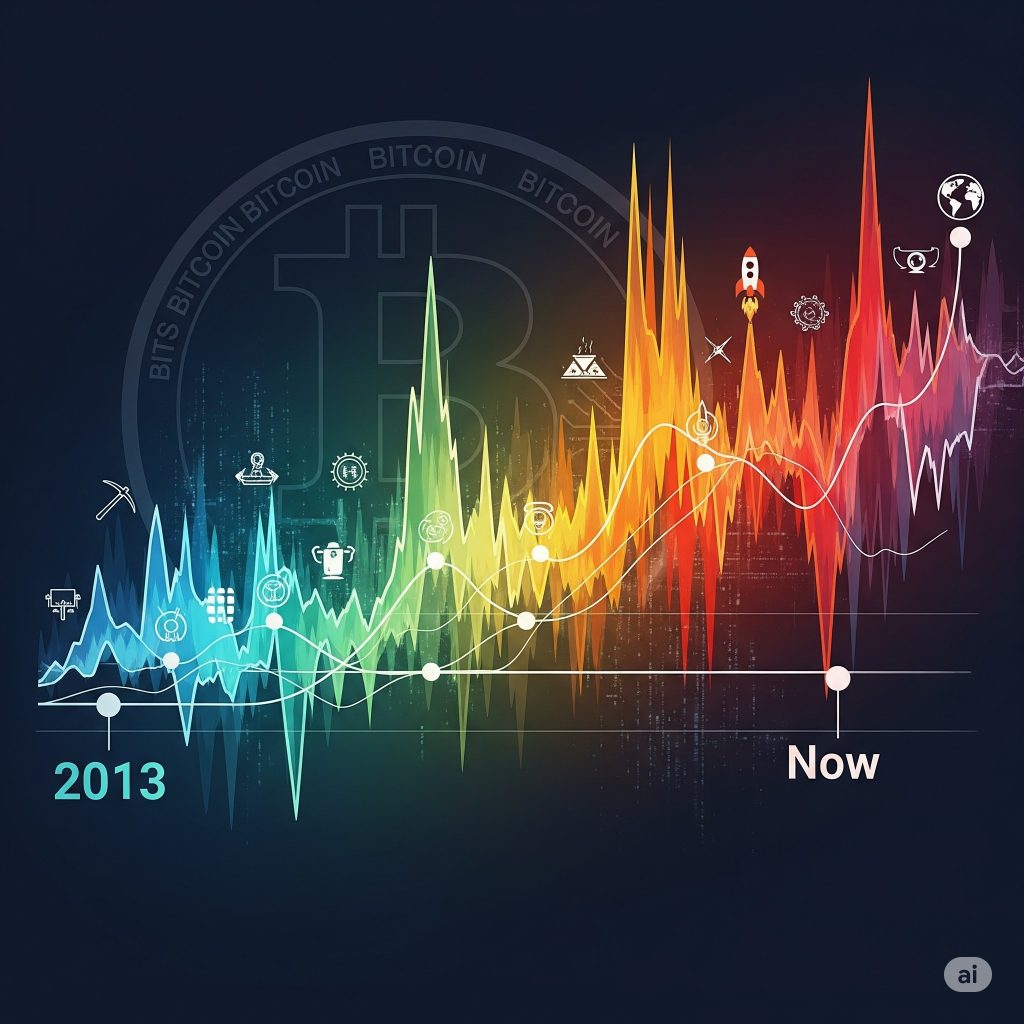
Bitcoin Chart
Why Bitcoin Is Humanity’s Hardest Money
The Evolution of Money
Throughout history, the hardest money—money that’s most difficult to increase in supply—has emerged as the dominant store of value. Gold served this purpose for centuries because of its unique properties: durability, divisibility, portability, and relative scarcity.
Bitcoin represents the next evolutionary step in money. It combines all of gold’s monetary properties while adding new capabilities impossible in the physical world: perfect divisibility, instant global transferability, and absolute supply verification.
Stock-to-Flow Superiority
Bitcoin’s stock-to-flow ratio—the relationship between existing supply and new production—surpasses even gold. While gold has a stock-to-flow ratio of approximately 60-70, Bitcoin’s ratio increases with each halving event, eventually approaching infinity as new Bitcoin production approaches zero.
This mathematical scarcity, combined with growing global adoption, creates a supply-demand dynamic unlike anything in human history. As Saifedean Ammous argues in “The Bitcoin Standard,” Bitcoin represents a return to sound money principles after decades of monetary debasement.
Institutional Adoption: The Smart Money Moves In
The narrative around Bitcoin has fundamentally shifted from speculative asset to institutional treasury reserve. Companies like MicroStrategy, Tesla, and Square have added Bitcoin to their corporate treasuries, while traditional financial institutions like BlackRock and Fidelity offer Bitcoin investment products.
This institutional adoption represents more than just price appreciation—it’s validation of Bitcoin’s role as a legitimate store of value in professional investment portfolios. When the world’s largest asset managers begin offering Bitcoin exposure to their clients, the era of Bitcoin as a fringe investment officially ends.
Beyond Bitcoin: The Broader Cryptocurrency Ecosystem
While Bitcoin remains the king of cryptocurrencies, savvy investors are also accumulating positions in other digital assets that serve complementary purposes:
Ethereum (ETH)
Often called “digital oil” to Bitcoin’s “digital gold,” Ethereum powers the world’s largest decentralized application ecosystem. With the transition to Proof of Stake and the implementation of EIP-1559, Ethereum has become deflationary during periods of high network usage.
Solana (SOL)
High-performance blockchain designed for large-scale decentralized applications and crypto-currencies. Its speed and low transaction costs have attracted significant developer activity and institutional interest.
Chainlink (LINK)
The dominant decentralized oracle network connecting blockchains to real-world data. As smart contracts become more complex, Chainlink’s infrastructure becomes increasingly valuable.
Polygon (MATIC)
Ethereum scaling solution that’s become the platform of choice for many decentralized applications seeking lower fees and faster transaction times.
These assets represent different aspects of the decentralized financial future, but Bitcoin remains the foundational layer—the reserve asset that anchors the entire cryptocurrency ecosystem.
The Devastating Reality of Market Timing
The Impossibility of Perfect Timing
Attempting to time Bitcoin markets has proven disastrous for most investors. The cryptocurrency’s volatility makes short-term predictions nearly impossible, while its long-term trajectory has consistently rewarded patient holders.
Data from multiple market cycles shows that time in the market beats timing the market for Bitcoin investors. Those who held through the volatility experienced exponential wealth creation, while active traders typically underperformed simple buy-and-hold strategies.
The Regret of Watching from the Sidelines
Perhaps the most painful experience for former Bitcoin holders is watching their sold assets appreciate without them. Social media is filled with stories of individuals who sold Bitcoin at $100, $1,000, or $10,000, only to watch it climb to $69,000 and beyond.
This psychological pain isn’t just about money—it’s about recognizing that you identified a revolutionary technology early but lacked the conviction to hold through the inevitable volatility. The regret compounds with each new all-time high.
Building Generational Wealth Through HODLing
The Power of Compound Appreciation
Bitcoin’s price appreciation hasn’t been linear—it’s been exponential. This creates a compound effect where early holders experience wealth creation that extends far beyond their initial investment. The difference between selling after a 2x gain versus holding through multiple cycles can mean the difference between a nice profit and generational wealth.
Setting Up Future Generations
The most successful Bitcoin investors think beyond their own financial needs. They’re accumulating Bitcoin not just for retirement, but as an inheritance for their children and grandchildren. This generational thinking encourages longer holding periods and reduces the temptation to sell during temporary price spikes.
A Final Word: The Choice Is Yours
As you read this, you face a decision that countless others have faced before you. Will you be the person who sold Bitcoin for a quick profit, or will you be among those who recognized its true potential and held through the volatility?
The stories of premature sellers serve as expensive lessons in the importance of conviction and long-term thinking. Bitcoin isn’t just another investment—it’s a revolutionary monetary technology that’s still in its early adoption phase.
The choice between short-term gratification and long-term wealth building is ultimately yours. But remember: once you sell your Bitcoin, you join the ranks of those who must watch from the sidelines as the hardest money humanity has ever created continues its inexorable rise.
The question isn’t whether Bitcoin will reach new all-time highs—it’s whether you’ll still be holding when it does.
Where to Buy Bitcoin and Other Cryptocurrencies
Major Exchanges:
- Coinbase (coinbase.com) – User-friendly platform ideal for beginners
- Kraken (kraken.com) – Advanced trading features with strong security
- Binance (binance.com) – Largest global exchange with extensive altcoin selection
- Gemini (gemini.com) – Regulated exchange founded by the Winklevoss twins
Hardware Wallets (Recommended for Long-term Storage):
- Ledger Nano X – Industry-leading cold storage solution
- Trezor Model T – Open-source hardware wallet with advanced features
Additional Resources:
- Swan Bitcoin (swanbitcoin.com) – Dollar-cost averaging Bitcoin purchases
- Strike (strike.me) – Lightning Network-enabled Bitcoin buying and selling
- Cash App – Simple Bitcoin buying integrated with everyday banking
Remember: Not your keys, not your Bitcoin. Consider transferring your cryptocurrency to a hardware wallet for maximum security and control.