Inbox27.com

Bitcoin and Altcoin news

Category Archive : Bitcoin

Bitcoin price

Bitcoin Smashes $123K as U.S. Congress Enters ‘Crypto Week’

Genius Act and ETF Inflows Spark Historic Rally

Bitcoin hits a new all-time high of $123,000 amid U.S. Crypto Week. Discover how the Genius Act, ETF inflows, and pro-crypto legislation are fueling the rally and what it means for investors.

Bitcoin Hits New All-Time High Amid Crypto Week Frenzy

Bitcoin (BTC) has shattered expectations yet again, surging past $123,000 for the first time in history. This milestone, reached in mid-July 2025, is being fueled by a perfect storm of institutional interest, retail optimism, and most notably, a flurry of U.S. legislative activity dubbed “Crypto Week”—a rare alignment of government attention and crypto market momentum.

The surge represents a 27% year-to-date increase and comes at a time when Congress is seriously considering the Genius Act, a groundbreaking piece of legislation that could normalize and regulate stablecoin issuance through traditional banking institutions.

What Is Crypto Week and the Genius Act?

Crypto Week refers to a focused period in which U.S. lawmakers are reviewing a cluster of bills aimed at regulating and integrating digital assets into the broader financial system. The centerpiece of this legislative push is the Genius Act (Government-Endorsed Network for Issuing United Stablecoins), which proposes that FDIC-insured banks be allowed to issue stablecoins under direct regulatory oversight.

The Genius Act could revolutionize the stablecoin market by providing a regulatory framework that encourages institutional adoption while protecting consumers. In short, it’s the U.S. government’s most serious embrace of crypto yet.

Lawmakers on both sides of the aisle have shown surprising unity in support of the act, seeing it as a way to prevent the U.S. from falling behind in the global digital currency race.

Institutional Inflows Break Records

While the political theater unfolds, institutional money is pouring in. According to CoinShares, spot Bitcoin ETFs saw $2.2 billion in net inflows over a 48-hour period, with BlackRock’s Bitcoin Trust (IBIT) alone accounting for nearly $1 billion of that figure.

BlackRock and Fidelity now manage over $90 billion in Bitcoin ETF assets, underscoring a sharp shift from speculative interest to structured, long-term holdings.

“We’re seeing Bitcoin move from the hands of traders to the hands of institutions,” said Bitwise CIO Matt Hougan. “That’s the kind of structural change that sets the stage for sustainable growth.”

Bitcoin Social Media Dominance Signals Retail FOMO

According to Santiment, Bitcoin-related discussions now account for over 43% of all cryptocurrency chatter on platforms like Twitter, Reddit, and YouTube.

This social dominance indicates a possible resurgence in retail FOMO (fear of missing out), which historically has preceded sharp price accelerations—or temporary corrections. Regardless, attention on Bitcoin is at its highest in months, aligning perfectly with bullish fundamentals.
Bitcoin price

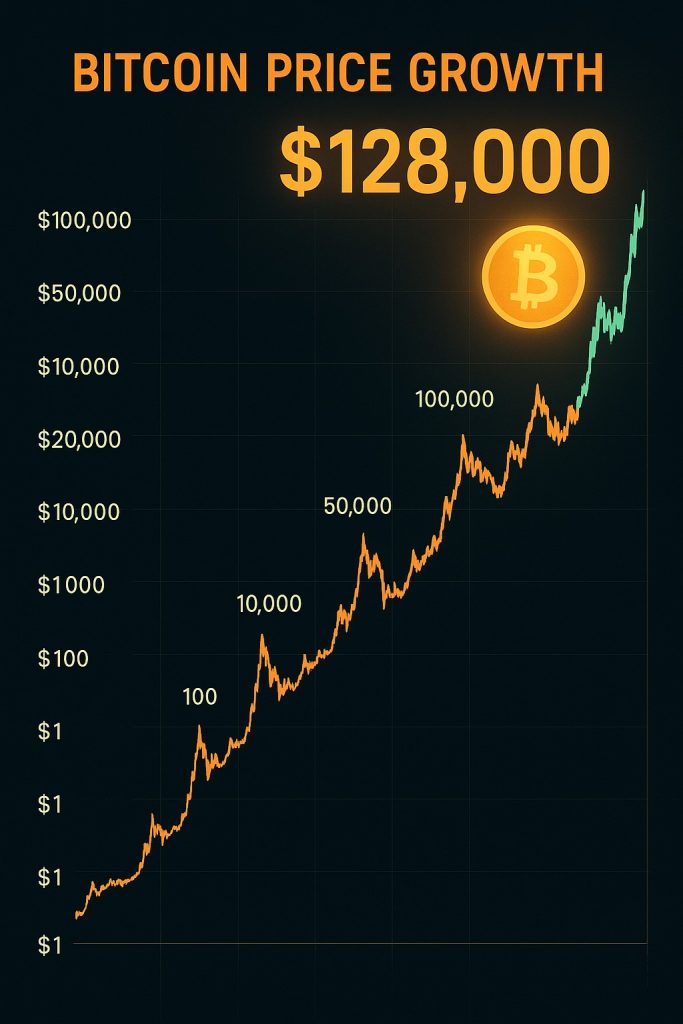
Bitcoin reaches 120k

Technical Analysis: What’s Next for Bitcoin?

Bitcoin broke through key resistance levels at $110K and $120K without much consolidation, signaling strong momentum. Analysts are now watching the $135K–$140K range for the next potential ceiling, while identifying $115K as the first level of meaningful support.

“If BTC consolidates above $120K for a few trading sessions, we may be looking at $150K before end of year,” said IG’s Tony Sycamore.

Short-term caution remains advisable, however, especially with macro headwinds like potential Fed rate hikes and geopolitical tensions still on the radar.

The Genius Act: Stablecoin Adoption at Scale

The Genius Act could open the floodgates for banks like JPMorgan Chase, Bank of America, and regional lenders to issue stablecoins pegged to the U.S. dollar under regulatory guardrails.

This represents a significant leap from the current Wild West model of unregulated stablecoin issuance. It may also pave the way for CBDC (central bank digital currency) pilot programs and enhanced payment rails domestically and abroad.

“The Genius Act provides the infrastructure for stablecoins to become as ubiquitous as debit cards,” said Crypto Council advisor Meltem Demirors.

Investor Takeaways: What Should You Do Now?

For Long-Term Holders

If you believe in Bitcoin’s value proposition as a hedge against fiat debasement and regulatory normalization, this may be a time to accumulate—especially on dips.

For Swing Traders

Volatility will be your friend in the coming days. Monitor resistance at $135K and support at $115K closely. Consider stop-loss placements below $112K.

For New Investors

If you’re new to crypto, start with ETF exposure (like IBIT or FBTC) to gain regulated access. Keep your allocation below 5% of your total portfolio.

Final Thoughts

Bitcoin’s rally past $123,000 is more than just another price surge—it’s a signal. A signal that institutions, lawmakers, and the general public are converging on the idea that crypto is not just here to stay, but ready to mature.

Crypto Week in Congress and the introduction of the Genius Act represent a historic pivot in the way America approaches digital assets. Combine that with record-setting institutional inflows and surging public interest, and Bitcoin’s path to $150K is beginning to look more like a matter of when—not if.

Stay informed, stay strategic—and stay bullish (with caution).

Bitcoin ATM

Bitcoin for the Masses: How Everyday People Are Driving Cryptos Expansion

Bitcoin is no longer just a niche asset for tech enthusiasts and institutional investors it’s becoming a financial tool embraced by everyday people worldwide. As adoption grows, Bitcoin’s demand continues to rise, reshaping the global financial landscape.

The Surge in Everyday Bitcoin Adoption
Recent data shows that Bitcoin ownership has skyrocketed among regular consumers. In 2025, approximately 425 million people globally own Bitcoin or have used it in transactions, marking a significant increase from 320 million users in 2022. In the U.S. alone, 28% of adults—around 65 million people own cryptocurrency, with Bitcoin being the most sought after digital asset.

This surge is driven by several factors
Financial Inclusion: Bitcoin provides access to financial services for people in regions with unstable banking systems.

Inflation Hedge: Many individuals see Bitcoin as a safeguard against inflation, especially in economies experiencing currency devaluation.

Ease of Access: The rise of Bitcoin ATMs and user friendly apps has made purchasing and using Bitcoin more accessible than ever.

How Bitcoin’s Growing Popularity Is Affecting Demand

Bitcoin’s increasing adoption is directly influencing its market dynamics. As more people buy and hold Bitcoin, its scarcity becomes more pronounced, driving up demand.

Bitcoin’s Price Growth: Bitcoin’s price has repeatedly broken the $100,000 barrier in 2025, reflecting heightened demand.
Institutional Investment: Over 70% of institutional investors now plan to invest in Bitcoin, further fueling its mainstream acceptance.
Transaction Volume: The Lightning Network, which enables faster Bitcoin transactions, now processes over 3 million transactions daily, making Bitcoin more practical for everyday use.

The Future of Bitcoin Adoption

Experts predict that Bitcoin will continue evolving into everyday money, with seamless payment systems making transactions as easy as tapping a card. Peer to peer commerce is also expanding, particularly in regions where traditional banking systems have failed.

As Bitcoin adoption grows, its role in global finance will become even more significant. Whether through remittances, retail payments, or long term investments, Bitcoin is cementing itself as a financial tool for the masses.

How to Invest in Bitcoin as Part of Your Financial Plan

If you’re ready to invest a portion of your income into Bitcoin, here’s a step by step action plan to help you get started safely and effectively.

1. Decide How Much to Invest
Experts recommend allocating 5% of your portfolio to Bitcoin, depending on your risk tolerance.
Invest only what you can afford to hold long term, as Bitcoin’s price can be volatile.

2. Choose a Secure Platform to Buy Bitcoin
There are several ways to purchase Bitcoin:
Cryptocurrency Exchanges: Platforms like Coinbase, Binance, Kraken, and Crypto.com offer easy access to Bitcoin.
Bitcoin ATMs: Convenient for cash purchases but often have higher fees.
Peer to Peer (P2P) Platforms: Services like Local Bitcoins and Paxful allow direct transactions between buyers and sellers.

3. Set Up a Secure Bitcoin Wallet
Hot Wallets: Mobile or web based wallets like Trust Wallet or Meta Mask are convenient but more vulnerable to hacks.
Cold Wallets: Hardware wallets like Ledger or Trezor provide offline storage for maximum security.

4. Make Your First Bitcoin Purchase
Deposit funds into your chosen exchange using a bank transfer, credit card, or PayPal.
Buy Bitcoin at the current market price or set a limit order to purchase at a specific price.
Transfer Bitcoin to your personal wallet for safekeeping.

5. Understand Market Trends and Expectations
Bitcoin’s price fluctuates, so expect short term volatility but long term growth potential.
Keep track of Bitcoin halving events, regulations, and institutional adoption, as they impact demand.
Consider dollar cost averaging (DCA)—investing a fixed amount regularly to reduce risk.

6. Stay Informed and Secure Your Investment
Follow trusted crypto news sources like CoinDesk, CryptoSlate, and Bitcoin Magazine.
Enable two factor authentication (2FA) on your exchange and wallet accounts.
Never share your private keys or recovery phrases with anyone.

Investing in Bitcoin is a long term strategy that requires patience and security awareness. By following this plan, you can safely integrate Bitcoin into your financial future while benefiting from its growing adoption.

Bitcoin as a US Reserve Asset

A Game-Changing Shift in Bitcoin’s Role as a National Reserve Asset

A Game-Changing Shift in Bitcoin’s Role as a National Reserve Asset

In a stunning development that could reshape the financial landscape, 20 U.S. states are introducing Bitcoin reserve bills—potentially setting off a $23 billion Bitcoin (BTC) buying spree. If successful, this move could drive Bitcoin’s price into new all-time highs, ignite a supply crunch, and solidify BTC as an integral part of America’s financial strategy.

Read More

Bitcoin Price Analysis February 2025

Bitcoin Weekly Price Analysis: Key Levels to Watch

Let’s dive into the exciting world of Bitcoin. Right now, Bitcoin’s market cap is a whopping $1.91 trillion. With a max supply capped at 21 million bitcoins, it’s no wonder this digital gold is such a hot topic and such a scarce asset.

Currently, Bitcoin is priced at $96,292, and it’s been on a steady rise on the weekly chart. The linear regression channel indicates significant resistance at $109,000 and strong support at $92,000. This sets the stage for potential price movements and strategic trading.

Support and Resistance Levels

The support level at $92,000 has been a strong foundation for Bitcoin, acting as a critical price floor during recent market fluctuations. On the other hand, the resistance level at $109,000 represents a key barrier that Bitcoin needs to overcome to reach new all-time highs. Support and resistance levels are crucial in understanding Bitcoin’s price movements and overall trend. Support levels act as a price floor, where buying interest is strong enough to prevent the price from falling further. This helps identify potential entry points for investors. Conversely, resistance levels serve as a price ceiling, where selling pressure is significant enough to cap further price increases. Recognizing these levels enables traders to make informed decisions, manage risk, and predict potential price reversals or breakouts, ultimately guiding their investment strategies in the volatile cryptocurrency market.

Market Sentiment

The overall sentiment in the Bitcoin market remains cautiously optimistic. While some investors are bullish about the potential for Bitcoin to break through the $109,000 resistance, others remain wary of potential pullbacks. A $120,000 Bitcoin is possible by the end of 2025. Despite the volatility introduced by President Trump’s trade wars, the cryptocurrency market, particularly Bitcoin, remains bullish due to several factors. Institutional demand for Bitcoin has surged, reaching unprecedented levels. Additionally, the potential for Bitcoin to be adopted as a strategic reserve asset by governments has bolstered investor confidence. The overall economic uncertainty has also driven investors towards Bitcoin as a hedge against traditional market fluctuations. These factors collectively contribute to the sustained bullish trend in the cryptocurrency market.

Future Potential

Looking ahead, some experts are predicting a future price target of $120,000 per bitcoin. This presents an exciting opportunity for investors, as breaking through the resistance levels could pave the way for significant gains.

Technical Indicators

The linear regression channel provides valuable insights into the market’s trend direction and potential price movements. By analyzing this indicator, investors can better understand the market’s momentum and make informed trading decisions. Several indicators suggest that Bitcoin may continue to rise in the long term. The Stock-to-Flow (S2F) model, which measures Bitcoin’s scarcity, indicates that Bitcoin is currently undervalued. Additionally, the Pi Cycle Top Indicator and Rainbow Price Chart suggest that Bitcoin has not yet reached its peak, with potential future targets significantly higher than current prices. These indicators, combined with increasing institutional adoption and macroeconomic factors, paint a bullish picture for Bitcoin’s long-term growth.

Investment Strategies

For long-term investors, holding onto Bitcoin through market fluctuations can be a viable strategy. The support level at $92,000 offers a safety net, while the potential for breaking through the $109,000 resistance presents an opportunity for significant gains. A dollar-cost averaging (DCA) strategy involves buying Bitcoin at regular intervals, such as weekly, regardless of its current price. This approach helps smooth out the cost of purchasing Bitcoin over time, reducing the impact of short-term market volatility. By consistently investing a fixed amount, investors can average out the purchase price, potentially lowering the overall cost and mitigating the risk of making large investments during market peaks. Over the long term, this strategy can lead to more stable returns and reduce the emotional stress of trying to time the market perfectly.

Short-term traders might consider taking advantage of price movements within the support and resistance levels. Buying near the support level and selling near the resistance level can yield profitable trades.

External Resources

To stay updated on the latest Bitcoin trends and market data, check out these resources:
– [CoinMarketCap](https://coinmarketcap.com/)
– [CoinGecko](https://www.coingecko.com/en/coins/bitcoin)

Influential Figures in Crypto

Here are some influential voices shaping the crypto space:
– Satoshi Nakamoto: The mysterious creator of Bitcoin: https://bitcoin.org.
– Elon Musk: A major advocate and influencer in the crypto world: https://en.wikipedia.org/wiki/Elon_Musk.
– Caitlin Long: A prominent advocate for Bitcoin and blockchain technology: https://caitlin-long.com/.

Here at Inbox27.com, we’re all about bringing you the latest and greatest in the crypto universe. Stay tuned for more insights and updates.

Connect with Inbox27.com
We’re all about bringing you the latest and greatest in the crypto universe here at Inbox27. We’d love to hear your thoughts, feedback, and comments! Feel free to reach out to us at contact@inbox27.com. Your input helps us continue providing valuable insights and updates.

If you found this content valuable, support us by sharing this article with your friends or family!


Bitcoin

How Donald Trump’s New Presidency Could Be a Game-Changer for Bitcoin and Crypto

It’s official—Donald Trump is back in the White House, and this time, he’s bringing some serious crypto vibes with him. If you’re a Bitcoin lover or just curious about what this means for the market, buckle up. Let’s dive into how his policies, executive orders, and even the launch of his very own cryptocurrency, $TRUMP coin, could shake up the world of digital assets.

Read More

Bitcoin Crash

Bitcoin Plummets to $95K: Is $65K Next?

The unthinkable has happened. Bitcoin, the titan of decentralized finance, has plummeted back to $95,000, sending shockwaves through the crypto community. Just weeks ago, Bitcoin was hovering near $110,000, defying critics and capturing imaginations worldwide. Now, the dramatic crash has left even seasoned hodlers stunned. How could this happen? Why now? And most importantly—what comes next?

Read More

Bitcoin ATM Machine

25 Businesses Where You Can Spend Bitcoin

25 Businesses Where You Can Spend Bitcoin

Bitcoin, the pioneering cryptocurrency, has gained significant traction in recent years, with more and more businesses accepting it as a form of payment. This growing adoption reflects the increasing ease of use and accessibility of Bitcoin, making it a convenient and secure option for both businesses and consumers.

Read More

Cryptocurrency Mull Market

How New Leadership Could Transform Crypto Regulations

How New Leadership Could Transform Crypto Regulations

The winds of change are sweeping through the crypto world as the United States gears up for a new administration. With each shift in leadership comes the potential for significant regulatory changes, especially in an area as dynamic and rapidly evolving as cryptocurrency.

Read More

Bitcoin is Digital Gold

Bitcoin’s Potential as Digital Gold: A Comparison with Gold as a Store of Value and Safe Haven Asset

For centuries, gold has been regarded as the ultimate store of value and safe haven asset, a hedge against inflation, economic downturns, and geopolitical risks. However, with the rise of digital currencies, particularly Bitcoin, the financial landscape is changing. Many proponents argue that Bitcoin is the “digital gold” of the 21st century. But how valid is this comparison? Let’s dive into the similarities and differences between Bitcoin and gold in terms of being a store of value and safe haven asset.

Read More

Interest Rates

The Impact of Central Banks and Interest Rates on Crypto

How the Federal Reserve, Central Banks, and Interest Rates Impact the Crypto Market

Introduction

The cryptocurrency market is known for its volatility and rapid changes, often influenced by various economic factors. Among these, the policies and actions of the Federal Reserve and other central banks play a crucial role. This blog post explores how interest rates set by these institutions impact the crypto market, affecting everything from investor behavior to market stability.

Understanding Interest Rates and Central Banks

Central banks, such as the Federal Reserve in the United States, use interest rates as a tool to control economic activity. By adjusting the federal funds rate, they influence borrowing costs, consumer spending, and overall economic growth. Lower interest rates typically encourage borrowing and spending, while higher rates aim to curb inflation by making borrowing more expensive.

Read More